

Audio By Carbonatix
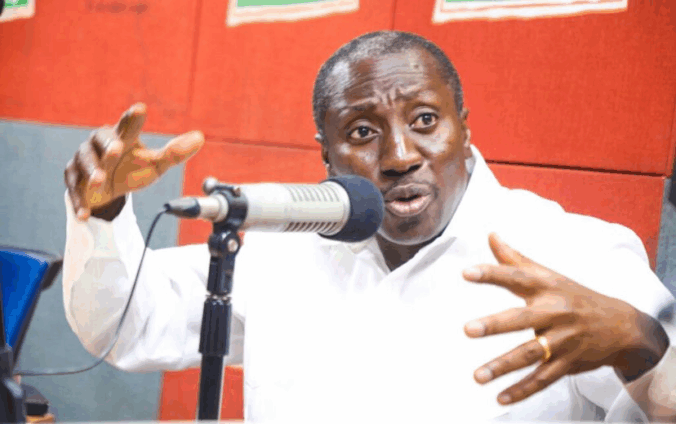
The Minority Leader, Alexander Afenyo-Markin, has called for urgent action to strengthen Ghana’s domestic economy, warning that changes in the global order pose a direct and serious threat to smaller economies.
Addressing a press conference on Monday, Afenyo-Markin said Ghana could no longer rely on traditional narratives of mutual benefit in international economic relations, arguing that global integration is increasingly being used as a tool of pressure and control.
“For a smaller economy like Ghana, this is not an abstract debate; it is a direct challenge,” he said. “We cannot rely on comfortable stories of mutual benefit when the structures of global integration are being used as instruments of leverage.”
According to the Minority Leader, the evolving global environment requires a clear and deliberate national response, starting with the building of a strong and resilient domestic economy.
He stressed the need for strategic autonomy to shield the country from external manipulation through debt, currency volatility or over-dependence on a single export commodity.
“We need enough strategic autonomy so that no outside power can bend us through debt traps, currency games, or control over one key export,” he stated.
“Economic sovereignty cannot remain a slogan; it must become the solid foundation of an independent foreign policy.”
Afenyo-Markin also underscored the importance of diversifying Ghana’s international partnerships.
He called for deeper economic and political engagement within Africa, while maintaining balanced and cautious relations with traditional partners such as the United States, the European Union, the United Kingdom, China and Canada, as well as emerging global powers.
He warned against over-reliance on any single country or bloc, insisting that cooperation must not come at the expense of Ghana’s sovereignty.
Beyond economic strategy, the Minority Leader argued that Ghana’s foreign policy must be grounded in the constitutional values practised at home.
He criticised what he described as a misguided form of pragmatism that tolerates corruption, impunity and injustice in the name of realism.
“A so-called pragmatic policy that turns a blind eye to impunity, corruption and injustice inside our borders is not realism,” he said. “It is a performance of sovereignty that hides a quiet acceptance of dependence. We cannot project moral clarity abroad if we refuse to practise it at home.”
Latest Stories
-
GSE showed strong performance in August 2026 despite recording more stock losses
40 minutes -
If CJ needs ethics law to know SOE comments were wrong, he may not be worthy of office – Arthur Kennedy
2 hours -
Stop touring state agencies and focus on the Judiciary’s problems – Arthur Kennedy to CJ
2 hours -
Apologise and don’t do it again – Arthur Kennedy to Chief Justice over SOE comments
2 hours -
Chief Justice remains committed to judicial independence, justice and equality – Judicial Service
2 hours -
Ghana concludes evacuation of citizens from South Africa; total returnees reach 1,900 – Ablakwa
3 hours -
Africa must define its own green transition path – Prof Fatima Denton
3 hours -
WASSCE 2026: English Language performance falls to 62.4% – WAEC
3 hours -
WASSCE 2026: Social Studies records sharp rebound as Maths, Science also improve
4 hours -
2026 WASSCE entry rises by 11% as 512,862 candidates sit exams
4 hours -
WASSCE 2026: English Language performance falls to 62.4% – WAEC
4 hours -
WAEC cancels 2026 WASSCE results of 8,295 candidates over examination irregularities
4 hours -
WAEC releases provisional 2026 WASSCE results for 512,862 candidates
5 hours -
CJ’s remarks on SOEs were made in good faith, not to undermine judicial independence – Judicial Service
8 hours -
Bright Future Alliance pays courtesy call on Akufo-Addo, invites him to African Leaders of Influence Lectureship Series
8 hours