

Audio By Carbonatix
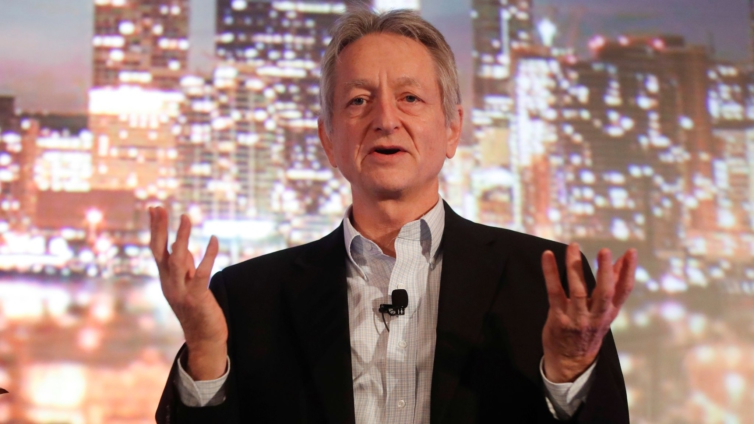
Geoffrey Hinton, who has been called the ‘Godfather of AI,’ confirmed Monday that he left his role at Google last week to speak out about the “dangers” of the technology he helped to develop.
Hinton’s pioneering work on neural networks shaped artificial intelligence systems powering many of today’s products.
He worked part-time at Google for a decade on the tech giant’s AI development efforts, but he has since come to have concerns about the technology and his role in advancing it.
“I console myself with the normal excuse: If I hadn’t done it, somebody else would have,” Hinton told the New York Times, which was first to report his decision.
In a tweet Monday, Hinton said he left Google so he could speak freely about the risks of AI, rather than because of a desire to criticize Google specifically.
“I left so that I could talk about the dangers of AI without considering how this impacts Google,” Hinton said in a tweet. “Google has acted very responsibly.”
Jeff Dean, chief scientist at Google, said Hinton “has made foundational breakthroughs in AI” and expressed appreciation for Hinton’s “decade of contributions at Google.”
“We remain committed to a responsible approach to AI,” Dean said in a statement provided to CNN. “We’re continually learning to understand emerging risks while also innovating boldly.”
Hinton’s decision to step back from the company and speak out on the technology comes as a growing number of lawmakers, advocacy groups and tech insiders have raised alarms about the potential for a new crop of AI-powered chatbots to spread misinformation and displace jobs.
The wave of attention around ChatGPT late last year helped renew an arms race among tech companies to develop and deploy similar AI tools in their products.
OpenAI, Microsoft and Google are at the forefront of this trend, but IBM, Amazon, Baidu and Tencent are working on similar technologies.
In March, some prominent figures in tech signed a letter calling for artificial intelligence labs to stop the training of the most powerful AI systems for at least six months, citing “profound risks to society and humanity.”
The letter, published by the Future of Life Institute, a nonprofit backed by Elon Musk,came just two weeks after OpenAI announced GPT-4, an even more powerful version of the technology that powers ChatGPT.
In early tests and a company demo, GPT-4 was used to draft lawsuits, pass standardized exams and build a working website from a hand-drawn sketch.
In the interview with the Times, Hinton echoed concerns about AI’s potential to eliminate jobs and create a world where many will “not be able to know what is true anymore.”
He also pointed to the stunning pace of advancement, far beyond what he and others had anticipated.
“The idea that this stuff could actually get smarter than people — a few people believed that,” Hinton said in the interview.
“But most people thought it was way off. And I thought it was way off. I thought it was 30 to 50 years or even longer away. Obviously, I no longer think that.”
Even before stepping aside from Google, Hinton had spoken publicly about AI’s potential to do harm as well as good.
“I believe that the rapid progress of AI is going to transform society in ways we do not fully understand and not all of the effects are going to be good,” Hinton said in a 2021 commencement address at the Indian Institute of Technology Bombay in Mumbai.
He noted how AI will boost healthcare while also creating opportunities for lethal autonomous weapons.
“I find this prospect much more immediate and much more terrifying than the prospect of robots taking over, which I think is a very long way off.”
Hinton isn’t the first Google employee to raise a red flag on AI. In July, the company fired an engineer who claimed an unreleased AI system had become sentient, saying he violated employment and data security policies.
Many in the AI community pushed back strongly on the engineer’s assertion.
Latest Stories
-
Police restore calm at Larteh following Odwira festival disturbance
38 minutes -
‘All the camps will dissolve’ – Bawumia demands one NPP for 2028
40 minutes -
There is no time to waste – Bawumia orders NPP to begin 2028 work
48 minutes -
Sarkodie visits MobileMoney Fintech LTD
50 minutes -
John Boadu unveils new NPP strategy to win back youth and modernise party
56 minutes -
Hawa Koomson elected NPP National Women’s Organiser
59 minutes -
John Boadu begins NPP rebuild from grassroots ahead of 2028 election
59 minutes -
Titus Glover wins NPP National Organiser race on second attempt
1 hour -
Winning 2028 election won’t be easy; we must work harder – Bawumia
1 hour -
You’ll be part of 2028 campaign; there’s enough work for all of us – Bawumia to NPP aspirants
1 hour -
John Boadu moves to unite NPP after heated leadership contest
1 hour -
Today is not a day of victory but a day of responsibility and great unity – John Boadu
1 hour -
Let us choose unity over division – John Boadu to NPP
1 hour -
Our task is to build a renewed NPP – John Boadu
1 hour -
Teamwork, discipline will drive NPP’s 2028 victory – Justin Kodua after retaining General Secretary position
1 hour