


Audio By Carbonatix
A new UN report says the world needs to rapidly raise investment in early warning systems for extreme weather events.
Over the past 50 years, recorded disasters have increased five-fold, thanks in part to climate change.
The study warns that one in three people on Earth are not adequately covered by warning systems.
The numbers of people in need after natural disasters could increase by 50% over the next decade.
The State of Climate Services 2020 has been produced by experts from 16 international agencies and financial institutions, and co-ordinated by the World Meteorological Organization (WMO).
Over the past 50 years, it says, some 11,000 disasters involving weather, climate and water-related hazards have occurred claiming two million lives and causing more than $3.5 trillion in economic losses.
In 2018, around 108 million people sought help from international agencies to cope with natural disasters.
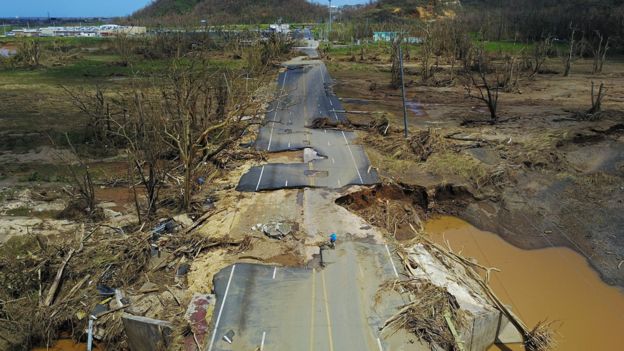
The authors of the new report say that by 2030 this number could increase by 50% at a cost of around $20bn a year.
Effective early warning systems are key says the study - And the researchers who have compiled it are calling for a change in emphasis from simply forecasting what the weather will be, to showing the impact of that weather system.
Good quality warning systems are critically needed in the least developed countries and in small island states.
These countries have lost billions to weather and climate related disasters over the past five decades.
Around 70% of the deaths connected to these disasters occurred in the poorest nations.
Yet according to the WMO, just 26% of weather observation networks in Africa meet their standards.
The advent of the coronavirus has made the building of early warning systems more difficult the report says.
But it shouldn't distract from the need to help poorer people to cope with natural disasters, made worse by climate change.
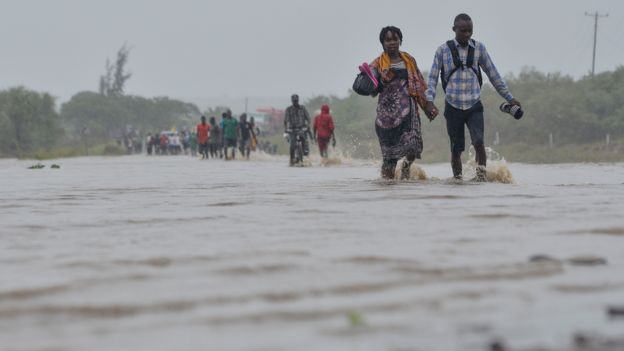
"Being prepared and able to react at the right time, in the right place, can save many lives and protect the livelihoods of communities everywhere," said WMO Secretary-General Prof Petteri Taalas.
"While Covid-19 generated a large international health and economic crisis from which it will take years to recover, it is crucial to remember that climate change will continue to pose an on-going and increasing threat to human lives, ecosystems, economies and societies for centuries to come," he said.
The report outlines six recommendations that the authors say are critical:
- Invest to fill the early warning systems capacity gaps, particularly in Africa's least developed countries and in small island states.
- Focus investment on turning early warning information into early action.
- Ensure sustainable financing of the global observing system that underpins early warnings.
- Track finance flows to improve understanding of where these resources are being allocated in relation to early warning system implementation needs and what impact this is having.
- Develop more consistency in monitoring and evaluation to better determine early warning systems effectiveness.
- Fill the data gaps, particularly in small island developing states.
"Covid-19 has made risk everybody's business," said Mami Mizutori, who is the special representative of the UN secretary-general for disaster risk reduction.
"We need to carry this understanding and momentum into the much bigger fight for our planet against the larger, stronger, more devastating climate emergency."
The report has been released on the International Day for Disaster Risk Reduction.
Latest Stories
-
Ronaldo wants Portugal ‘punishment’ but not retiring
12 minutes -
White House defends Trump comment to let Iran ‘take out’ LA and San Diego
21 minutes -
Asos confirms hackers sent ‘unauthorised’ notification to app users
22 minutes -
US televangelist Jim Bakker, disgraced from sex scandal and fraud, dies at 86
30 minutes -
Congolese-born golfer to represent Ghana at Turkish Airlines World Cup grand final
37 minutes -
Amazon wins global rights to stream Emmys in six-year deal
38 minutes -
European Film Festival returns to Ghana after a 5-year break
43 minutes -
PTA backs teachers’ strike, threatens street protest if gov’t misses October 30 deadline
47 minutes -
Paramount takes over Warner Bros in $110bn Hollywood merger
47 minutes -
Suspend offshore gold exploration licence – NAFAG urges gov’t
48 minutes -
Investigators meet family, community over deaths of 3 children found in car trunk
56 minutes -
Teacher strike: FWSC blames new allowance demand for deadlock with teacher unions
1 hour -
Aboboyaa Company Ltd CEO donates 5 tricycles to Ghana Prisons Service
2 hours -
National Cathedral: ‘There’s no clarity as to what they want to use the site for’ – Afenyo-Markin on site’s future
2 hours -
Investigators meet family, community over deaths of 3 children found in car trunk
2 hours