

Audio By Carbonatix
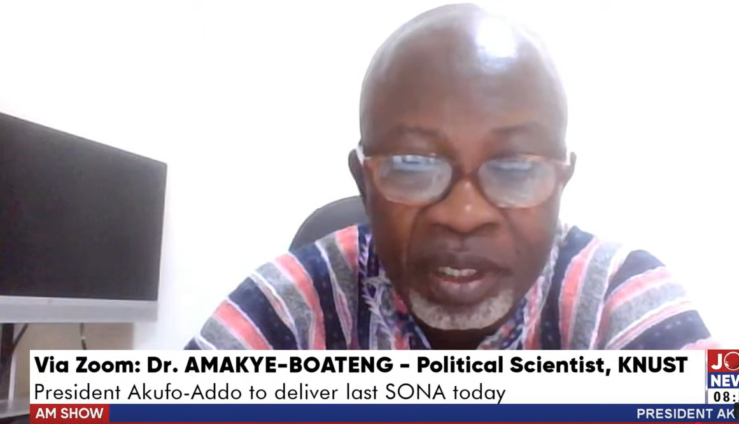
A political scientist at the Kwame Nkrumah University of Science and Technology (KNUST), Dr Amakye -Boateng has criticised the outgoing government for its failure to effectively implement decentralisation policies.
Speaking on the AM Show on JoyNews, Dr Boateng emphasised the need for significant reforms to empower local governance structures and improve grassroots development.
Dr Boateng highlighted past promises to allow the election of Metropolitan, Municipal, and District Chief Executives (MCEs and DCEs), which he said were poorly executed. “There was a call for MCEs and DCEs to be elected, and while the government attempted to address it, they included elements that were offensive to Ghanaians," he said.
He pointed out that the government’s failure to empower municipal and district areas has left decentralisation as an idle concept. “Municipalities and districts should have been granted the autonomy to manage their budgets and undertake development projects independently. Instead, the central government continues to make decisions that are simply implemented at the local level. This is not true decentralisation, it’s decentralisation in name only,” Dr Boateng asserted.
To deal with these shortcomings, Dr Boateng proposed that the incoming government allow local government officials to be elected on a non-partisan basis. “We need to break away from partisan politics in electing officers at the municipal and district levels. Individuals should contest based on merit and their ability to deliver, not party affiliation. This would foster genuine accountability and development,” he said.
Dr Boateng also expressed cautious optimism about the leadership of President-elect John Mahama, attributing it to his extensive experience in governance. “John Mahama’s unique journey from rising through the ranks of governance to being president, losing an election, and observing from the sidelines offers him a rare opportunity to correct past mistakes and chart a better path for Ghana,” he remarked.
He urged the incoming administration to learn from the shortcomings of the current government and take decisive action to implement effective reforms. “This is an opportune time for the incoming government to deliver meaningful progress and address the longstanding issues of decentralisation,” Dr Boateng concluded.
Latest Stories
-
Power restoration fault suspected in Kumasi Central Market fire
59 minutes -
The 7-foot giant of Ngleshie Amanfro: Seven-foot Ghanaian Ephraim Saawa dreams of joining the national basketball team
2 hours -
Government promises support for Kumasi Central Market fire victims
2 hours -
Vibes The Movie: Big Ghun’s Ghanaian film earns five nominations at 2026 REFFA
2 hours -
MamaCare CEO warns unresolved conflicts among health workers could undermine maternal and neonatal care
3 hours -
Health professionals urged to translate medical knowledge into practice to save mothers
3 hours -
Conflicts among care providers linked to maternal, neonatal deaths – Expert
4 hours -
GIS marks 10th TIME conference, champions improved teaching practices
4 hours -
BRICS Or Balance? What Ghana’s bid really means
5 hours -
GPRTU wants full TRAFFITECH-GH implementation to start in 2027
5 hours -
Mahama announces plans to import electric wheelchairs for PWDs
5 hours -
KGL U17 Colts 2026: Western beat Prempeh Elite Academy to set up final final with Greater Accra Region
6 hours -
Late Solanke strike salvages 10-man Spurs draw at Man United
6 hours -
Gender Ministry to monitor welfare of Nana Akua Addo’s children amid domestic violence case
6 hours -
Benedict Okyere Yeboah: Ghana’s football problem goes beyond sacking a coach
6 hours