

Audio By Carbonatix
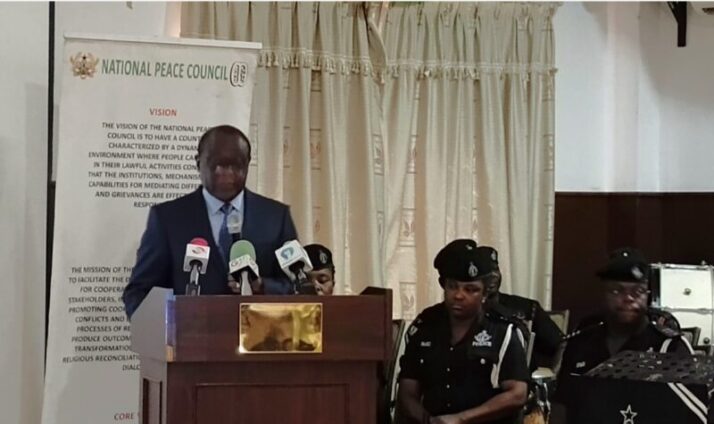
Ahead of the December 7 general election, Reverend Dr Ernest Adu-Gyamfi, the Chairman of the National Peace Council (NPC), has urged Ghanaians to choose peace.
He urged all political parties, institutions, and citizens to use non-violent means to resolve conflicts.
“Disagreements are inevitable in any democracy, but how we choose to address them will determine whether we build a peaceful and prosperous nation or one divided by violence and mistrust,” Rev Dr Adu-Gyamfi remarked at the fifth National Peace Council Stakeholders’ Dialogue in Accra.
He said: “We have a choice to make in the upcoming elections: the choice between peace and violence. I implore you all to choose peace, for now is the time to safeguard our democracy and work together to build a peaceful Ghana for generations to come.”
The event on the theme, “Building Trust among Stakeholders for a Peaceful 2024 General Elections in Ghana”, was organised by the Peace Council in collaboration with the United Nations Office for West Africa and Sahel (UNOWAS).
It was based on stakeholders’ shared responsibility to ensure that the upcoming election manifests their commitment to democracy, peace, and national unity rather than another political exercise.
The NPC has already organised similar events in Tamale, Kumasi, Ho and Cape Coast.
These dialogues are meant to strengthen the ongoing collaboration between political actors and institutions represented here to enhance the peace and stability of the country.
Rev Dr Adu-Gyamfi said Ghanaians could not overlook the worrying trends taking place all over the world currently; adding that some countries that were once considered as strongholds of justice, freedom and democracy were increasingly under threat.
He said the basic mechanisms of democracy were being questioned in nations like the United States, which had long been seen as a defender of democratic ideals.
He noted that elections, which ought to be a peaceful means for people to select their leaders, had unfortunately turned into hotspots for violence leading to the loss of life and property.
“Regrettably, this trend has affected our sub-region as well. Unimaginable crimes such as crimes against humanity, ethnic cleansing, and genocides have occasionally resulted from the way elections have been held,” the Chairman said.
“These incidents highlight how urgently all parties involved in democracies, particularly in Africa, have to foster a deeper culture of trust, collaboration, and peace”.
He said the African Union’s Agenda 2063 envisions a continent that was peaceful and secure, characterized by inclusive growth and sustainable development stating that this ambitious vision includes an Africa that practices good governance, democracy, respect for human rights, justice, and the rule of law.
He said it envisages an Africa with a strong cultural identity, values, ethics and a continent where development is driven by Africans for Africans, and that unfortunately, this vision remains far from reality.
He said in Ghana, Ghanaians were fortunate to have a robust democratic system and that the 2020 general election were largely peaceful, and the legal processes that followed were conducted with dignity.
He said however, the National Peace Council and other well-meaning Ghanaians were deeply concerned about the pockets of unrest, reckless public utterances, and instances of hate speech that marred certain areas of the electoral process; stating that the most troubling of all were the violent incidents that led to the destruction of lives and property during the 2020 general election.
The Chairman underscored the Council remains committed to fulfilling its mandate of facilitating and developing mechanisms for conflict prevention, management, and resolution.
Madam Barrie Freeman, Deputy Special Representative of the UN Secretary-General for West Africa and Sahel, said going forward, the UN would continue to support Ghana to ensure that its democracy delivers the developments that its citizens need.
Dr Mohamed Ibn Chambas, the African Union (AU) High Representative for Silencing the Guns and Chairman of the AU High-Level Panel on Sudan, appealed to Ghana’s Electoral Commission (EC) to ensure that it conducts free, fair and credible polls.
He also urged the security agencies to ensure there was peace and order before, during and after the December 7 elections.
Mr Charles Abani, the UN Resident Coordinator to Ghana, said as Ghana approaches the December 7 elections, he was urging all stakeholders to prioritize dialogue to resolve any arising issue and to remain committed to a peaceful electoral process.
Latest Stories
-
Brandon Asante and Coventry all but promoted to Premier League despite Sheffield Wednesday draw
21 minutes -
GPL 2025/26: Late Kwartemaa strike downs Hearts in Tema
27 minutes -
Ghana Faces Sierra Leone Moment as Prosecutorial Powers come under strain
37 minutes -
Don’t consume fish or seafood from Tema Shipyard until further notice – FDA warns
42 minutes -
Why volunteering might be Africa’s most underrated career accelerator
48 minutes -
ActionAid Ghana raises concern over gender gaps in Feed Ghana Programme
50 minutes -
Windstorm wreaks havoc in Gushegu, displacing nearly 2,000 residents and damaging schools
52 minutes -
Friends of Bridget Bonnie Marks her 35th birthday with donation to Kasseh Model Health Centre
2 hours -
From Ekumfi Kokodo to the Pulpit Stage: Essi Donkor’s gospel journey takes shape
2 hours -
Landfilling waste management creates no value, it’s an economic waste
2 hours -
Photos: Speaker Bagbin Commissions MPs constituency office under parliamentary decentralisation programme
2 hours -
Black Stars technical advisor Winfried Schäfer sacked as GFA shakes up backroom staff
2 hours -
Wenchi water project almost complete, critical to gov’t agenda – GWL MD
3 hours -
Anti-LGBTQ+ bill not part of government’s legislative agenda – Inusah Fuseini
3 hours -
Anti-LGBTQ Bill: Forget the rumour mongers, I’m a man of action, and will pass the bill – Speaker
4 hours