

Audio By Carbonatix
Environmental degradation is costing the nation $6.3billion annually or nearly 11 percent of the country’s 2017 Gross Domestic Product, according to the World Bank’s latest Ghana Country Environmental Analysis.
The report which is part of the Bretton Wood's institution diagnostic study on the economy revealed that non-renewable resources such as gold and oil cannot sustain growth as resources deplete, while renewable resources like cocoa, timber, and other tree and food crops, depend on good environmental stewardship.
There are also clear signs and scientific evidence that the erosion of the natural capital may put at risk growth, livelihoods, and human health, it stated.
Ghana has managed remarkable success in economic growth over the past two decades. Since 1990, real GDP has more than quadrupled, and in 2011 the country hit a significant milestone when it joined the ranks of Lower Middle-Income Countries (LMICs).
Momentum in macroeconomic growth was also accompanied by reduced poverty, allowing the nation to halve its national poverty rate from 52.7 to 24.2 percent during the period 1991-2012.
However, its international poverty headcount is lower than the LMIC average (World Bank, 2018a).
The report further said environmental unsustainability may impair Ghana’s economic growth, as demonstrated through two economic indicators.
The first is national wealth a gauge of growth sustainability. It measures a country’s assets in produced, natural (renewable and non-renewable), and human capital, and net foreign assets.
Between 2000 and 2014, Ghana saw total national wealth more than double.
However, much of the wealth increase came with losses to renewable natural resources and overreliance on non-renewable assets.
Per capita non-renewable natural capital—mainly from petroleum production—increased substantially from a very low base (US$36 to US$1,673).
In contrast, renewable natural capital per capita decreased more than seven percent, with specific declines in forests and protected areas assets.
In Ghana’s case, not only was renewable natural capital eroded, but produced capital was as well.
Air pollution
Air pollution, the number one environmental risk to public health, costs roughly $2 billion per year and causes the premature death of nearly 16,000 people each year.
The elderly account for most of the deaths, while more than half of the deaths from pneumonia in children under five is associated with air pollution.
Water poluution
Water Pollution causes significant damage equivalent to 3% of the GDP. This is due to the health effects of inadequate water supply, poor sanitation, and discharge of solid industrial and toxic waste into water systems.
Plastics pollution
Plastics pollution is rising to crisis proportions. Each day, over 3,000 metric tons of plastic waste is produced with much of it dumped as litter or placed into improvised landfills. This waste clogs open drainage systems and pollutes the ocean.
E-waste, associated with the Agbogbloshie dumpsite, is Accra’s main source of air pollution.
Over there, burning electronic parts cast carcinogenic compounds into the air while deposited toxic metals enter waterways and oceans.
Each year, exposure to lead and mercury-causing diseases and the lost IQ points in children cost $440 million.
Poor land management leads to land degradation, costing over US$500 million a year and to deforestation costing US$400 million a year: five million hectares of forest was lost between 2001 and 2015.
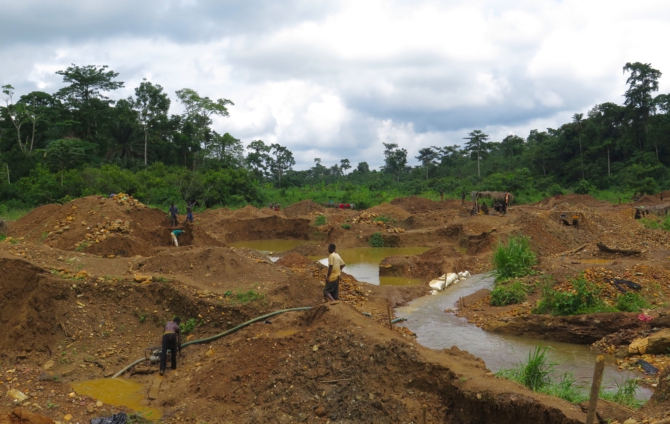
Over the past decade, artisanal gold mining aggravated the degradation as streams and rivers were dug up to find gold. Miners’ exposure to the toxic mercury also costs $240 million in health costs.
Ghana loses about 2.7 million m2 of its shore every year, with 80% of the shoreline actively eroding.
Coastal erosion and flooding are particularly serious in Greater Accra where sea level rise increases erosion intensity and raises the chance of flooding by 20%.
Also, climate change heavily affects climate- sensitive sectors on which Ghana’s growth is based - agriculture, forestry, and energy.
It also triggers environmental disasters: in the last 40 years, floods affected four million people and a 2015 flash flood in Accra caused $55 million in damages.
Rationale behind the study
The objective of the Ghana Country Environmental Analysis (CEA) is to analyze critical environmental and natural resources issues threatening sustainable economic growth and propose policy actions and investments to address them
Latest Stories
-
Oil prices climb as traders weigh Saudi supply risk, Russian diesel flow
15 minutes -
Zimbabwean author denies using AI to write award-winning story
24 minutes -
Bank of America hit with $1.2bn fine for money laundering failings
33 minutes -
Robot seized by German police after allegedly groping teenage girl
44 minutes -
Subject EC appointment to ‘Akufo-Addo test’ – Kwapong
54 minutes -
English football’s independent regulator would quit over Man City interference
1 hour -
Anthropic seeks rehearing of case over Pentagon’s security risk branding
1 hour -
Torrential rains in Libya’s Tripoli kill two
2 hours -
Guinea-Bissau says it has not approved hepatitis B vaccine trial in newborns
2 hours -
NDC Deputy National Organizer Aspirant Hamza Umar targets grassroots mobilisation
2 hours -
Partisan appointment cycle will persist without meaningful reforms – Osae-Kwapong
3 hours -
‘This cycle is not going to be broken any soon’ – Osae-Kwapong on partisan appointments
3 hours -
Partisan appointments won’t help restore trust in EC – Osae-Kwapong
4 hours -
Villarreal fight back to beat Napoli and end losing run
4 hours -
Tresoldi nets hat-trick as Club Brugge win Inter thriller
4 hours