

Audio By Carbonatix
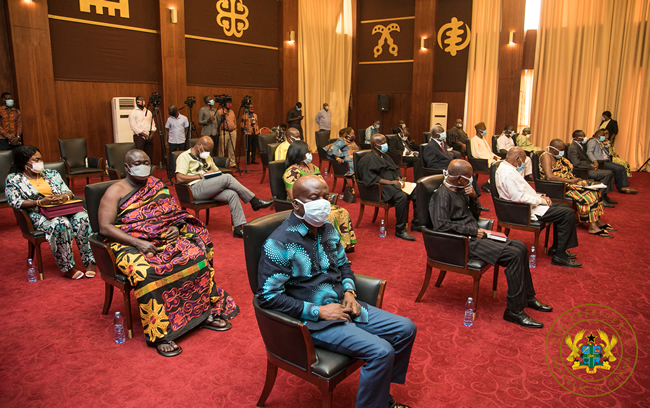
In Ghana, the Council of State is often described as a council of elders—a group of wise heads tasked with guiding the president through the thorny thickets of governance.
Established under Article 89 of the 1992 Constitution, this 31-member body is meant to provide guidance and advice to the president, parliament, the judiciary, and other state institutions on issues of national importance.
But as the country holds elections for new members, many Ghanaians are left wondering: is this council a powerhouse of influence or merely a ceremonial echo chamber?
The council’s composition is a curious mix of elected and appointed members. Sixteen regional representatives are elected by delegates from district assemblies, while the president appoints 11 members and, in consultation with parliament, selects three high-profile figures: a former Chief Justice, a former Inspector General of Police, and a former Chief of Defence Staff. Rounding out the group is the President of the National House of Chiefs, who serves as a de facto member.
In total, 14 of the 31 members—45% of the council—are directly or indirectly appointed by the president, raising questions about its independence.
This structure has not gone unchallenged. In 2011, the Constitutional Review Commission, set up by the National Democratic Congress (NDC) under President John Atta Mills, submitted its review report.
While the committee recommended maintaining the council, it also proposed reducing the president’s appointees from 11 to 5 to enhance its independence. The government, in its white paper, accepted the recommendation to retain the council but rejected the reduction of presidential appointees, leaving the balance of power unchanged.
The council’s tenure lasts until the end of the president’s term, ensuring continuity but also tying its fate to the executive’s political cycle.
Its role, however, is far from ceremonial. The council is consulted on key decisions, including the appointment of the Bank of Ghana Governor, the Chief Justice and Supreme Court Justices, the Inspector General of Police, and the Chairperson of the Electoral Commission.
It also advises on presidential pardons, diplomatic appointments, the removal of certain public officials, and legislative bills.
Yet, for all its advisory responsibilities, the council’s influence is not absolute. The Supreme Court has ruled that while the president is required to seek the council’s advice on certain matters, they are not bound to follow it. In other words, the council can advise, but the president can politely—or not so politely—ignore.
This has led critics to argue that the council risks becoming a rubber stamp, especially given the significant number of presidential appointees. Supporters, however, see it as a stabilizing force, offering experienced counsel and a layer of oversight in a young democracy.
As Ghana continues to strengthen its democratic institutions, the role of the Council of State remains a topic of lively debate. Is it a vital check on presidential power, or merely a ceremonial body with a fancy title?
The answer may lie in how future presidents choose to engage with it—or how often they choose to ignore it. For now, the council remains a curious blend of tradition and politics.
Latest Stories
-
Asantehene plants trees to commence Jimi Watercourse Rehabilitation destroyed by galamsey
21 minutes -
15 arrested, 6 trucks impounded over sandwinning activities on Kumasi-Accra Expressway
21 minutes -
OFFICIAL: Vinicius will miss El Clásico, suspended four games
25 minutes -
Prayer vigil held after four arson attack murders
32 minutes -
GRA fully recovers $154k legacy debt owed by foreign entities between 2022 and 2024
33 minutes -
Kwesi Pratt Jr warns bus preachers are adding to passengers’ stress with accident prophecies
34 minutes -
MTN Ghana to spend $1.1bn in 3 years, build 500 new sites as MoMo hits 44% Growth
36 minutes -
I have no regrets joining Assemblies of God – Mahama
37 minutes -
Starlink restrictions in Ukraine war linked to political situation, Zelensky aide says
39 minutes -
Furniture boost for Techiman North schools as MP donates to 20 institutions
40 minutes -
Assemblies of God to loan 10,000-seater dome for Ghana@70 celebrations
40 minutes -
Government to audit 2,016 community network sites – Communications Minister
40 minutes -
Heritage Series notes: BoG promises more inclusive cedi with improved sizes, tactile features
58 minutes -
‘We want answers’ – Family seeks probe into 14-year-old’s death 12 days after starting SHS
1 hour -
No preacher has the right to impose beliefs on bus passengers – Kwesi Pratt Jr backs preaching ban
1 hour