

Audio By Carbonatix
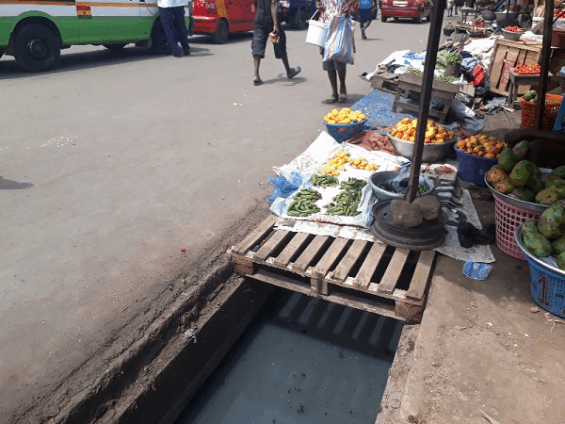
The Food and Drugs Authority has urged the public to stop buying food sold near open gutters, warning that the practice puts public health at risk.
According to the Deputy Chief Executive Officer at the FDA in charge of the Food Division, Roderick Daddey-Adjei, the common habit of preparing and selling food in unhygienic surroundings continues to undermine efforts to improve food safety across the country.
“Food should not be sold by a gutter, and we will not defend that,” Mr Daddey-Adjei said during a radio interview on Tuesday, February 3.
He described the situation as a long-standing cultural issue that calls for stricter enforcement alongside a shift in consumer behaviour.
“We have developed a bad culture over time. Sanitation and education must be taken seriously. If you care about food safety, a food seller, whether a waakye seller, kebab seller, or kenkey seller, should not be operating next to an open gutter,” he said.
Mr Daddey-Adjei said consumers have a role to play in protecting their own health by refusing to buy food from vendors who work in unsafe conditions.
“You need to educate the consumer so they can make informed choices. Without them, this will not work. The numbers are worrying, and enforcement on its own will not solve the problem,” he explained.
He said the Authority is running public education campaigns in markets and communities to help people identify unhygienic practices and choose safer food options.
“The FDA goes from market to market. We meet vendors, we engage market queens, and we teach the basics of food hygiene and handwashing. This work continues, but consumers also need to take responsibility,” he added.
Mr Daddey-Adjei said enforcement remains difficult, especially given the high number of informal food vendors across the country.
“The task is huge. Staffing is a challenge. Local assemblies are expected to monitor basic sanitation and hygiene, but our checks show that sometimes it is done and sometimes it is not,” he said.
He explained that under the Public Health Act, 2012 (Act 851), all food vendors, including itinerant sellers, must obtain permits and meet minimum hygiene standards before operating.
He admitted that compliance levels remain low and enforcement capacity is limited.
Mr Daddey-Adjei warned that poor food hygiene has direct consequences for public health, citing last year’s cholera outbreak which spread from the Western Region to Central and Greater Accra.
“When people understand the need to comply, they will do what is expected. Food safety affects everyone because when people fall sick, the impact is felt by all,” he said.
He urged the public to make safer choices by refusing to buy food sold in unhygienic locations.
“If people stop buying food sold next to gutters and other unsafe places, vendors will be forced to change how they operate. That is one of the strongest tools available to us,” Mr Daddey-Adjei said.
Latest Stories
-
Imagination Africa, Mentors Chess Academy to host second African Genius Chess Championship at Ghud Park
2 hours -
Nana B passport claims a diversionary tactic — Abu Jinapor
3 hours -
Pope Leo diagnosed with cancer as doctors remove lobe of lung, Vatican says
3 hours -
Legal Aid Commission takes free legal services to Techiman main lorry terminal
3 hours -
Nana B denies seeking passport favour, accuses Ablakwa of failing to account for GH¢16.4m
3 hours -
Young girls demand climate action, stronger protection against child marriage
3 hours -
Ex-gang boss sentenced to 40 years for orchestrating Tupac Shakur’s murder
3 hours -
From near-deferral to three awards: UMaT graduate’s academic journey
3 hours -
Atta Akyea denies seeking presidential pardon for Wontumi in galamsey case
4 hours -
Photos: Mahama commissions 85-bed Police Hospital ward, donates two ambulances
4 hours -
GTEC directs Ghana’s public universities to reopen by October 16 and begin lectures on October 19
4 hours -
Star Oil donates GH¢1million towards construction of new CID facility
4 hours -
Court hands Adjetey Sowah, two others lifetime bans after Amputee Football legal dispute
4 hours -
NDC appoints Julius Kwame Anthony as a Deputy Communications Director
4 hours -
Ghana repatriates 120 Nigerians rescued from suspected cybercrime centres
4 hours