


Audio By Carbonatix
A major shift in the fight against non-communicable diseases (NCDs) is underway as Ghana prepares to scale up a new community-based intervention, NCD-CareNet, alongside the rollout of an innovative digital nutrition tool, Nutribot, aimed at transforming prevention and long-term disease management.
The initiative, led by the National Institute for Health and Care Research (NHIR) through its NIHR Global Health Research Centre for Non-Communicable Disease Control in West Africa (STOP NCD), was highlighted at a global symposium in Accra from April 28 to April 30, bringing together health leaders, policymakers and researchers from over 12 countries.
The three-day meeting, held under the theme “Ensuring Sustainability from Global Health Research Centres", marked the transition from research and pilot phases into full-scale implementation of interventions designed to tackle the growing burden of chronic diseases across low- and middle-income countries.
From Research to Real-World Impact
Between 2022 and 2024, the STOP NCD research teams conducted extensive context analysis to understand the drivers of NCDs in Ghana and West Africa.
This was followed by stakeholder engagement to co-design practical, locally relevant solutions.
The programme has now entered the implementation and evaluation phase, where evidence-driven interventions are being deployed directly within health systems.
In West Africa, the STOP-NCD Centre, co-led by the Ghana College of Physicians and Surgeons (GCPS) and the London School of Hygiene and Tropical Medicine (LSHTM), is spearheading efforts across Ghana, Burkina Faso and Niger, in collaboration with Ashesi University (AU), the Laboratoire d'Études et de Recherche sur les Dynamiques Sociales et le Développement Local (LASDEL), and the Université Catholique de l'Afrique de l'Ouest – Unité Universitaire de Bobo-Dioulasso (UCAO-UUB).
NCD-CareNet: Ghana’s Community-Level Breakthrough
At the heart of Ghana’s response is NCD-CareNet, a comprehensive intervention designed to strengthen primary healthcare systems and bring services closer to communities.
The model integrates:
- Community-based screening for NCDs and risk factors
- Digital tracking through an electronic health (E-tracker) system
- Linkages to the Community Health Planning and Services (CHPS) framework
- Financial access through the National Health Insurance Scheme (NHIA)
This integrated approach ensures early detection, seamless referrals, and reduced financial barriers to treatment, key gaps that have long hindered NCD care.
Pilot implementation began in August–September 2025 in selected sub-districts within:
- Ga South
- Shai-Osudoku
- Kwahu Afram Plains North
Full implementation commenced in February 2026, with a scale-up across these districts set to begin on May 1, 2026.
Prof. Irene Agyepong, Co-Director of NIHR Global Health Research Centre for Non-Communicable Disease Control in West Africa (STOP-NCD), explained that the intervention is designed to respond to complex health system challenges through integrated, people-centred approaches.
She noted that the initiative strengthens referral systems, builds peer support networks for patients, and generates policy-relevant data to guide national decision-making.
Nutribot: Ghana’s Digital Weapon Against Lifestyle Diseases
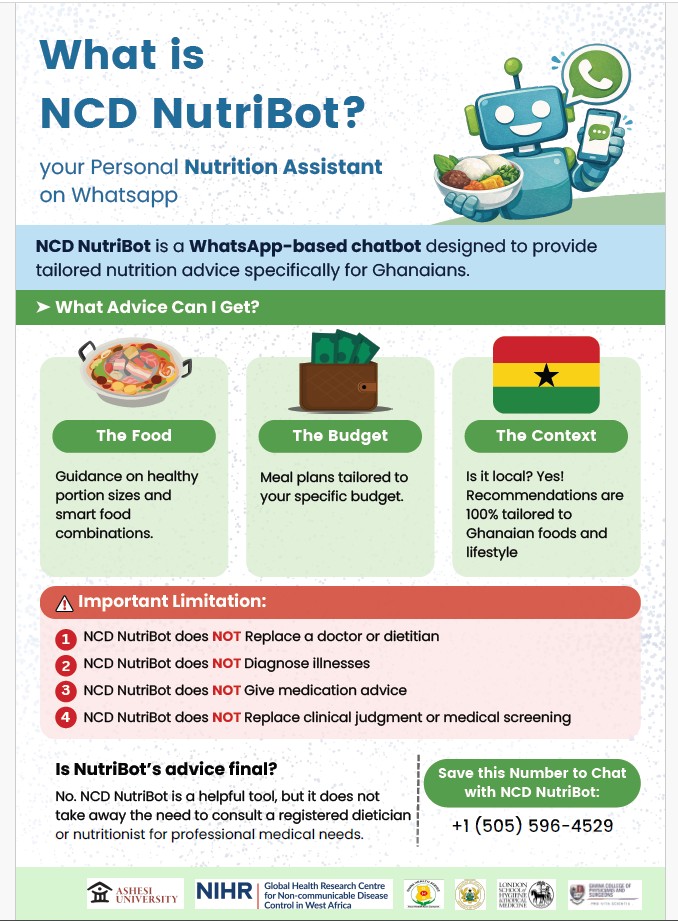
Complementing CareNet is the Nutribot component, a novel WhatsApp-based platform developed by the Ashesi University team led by Provost Prof. Angela Owusu-Ansah.
The tool delivers:
- Personalised nutrition advice
- Lifestyle guidance tailored to Ghanaian diets
- Accessible health education through mobile technology
Unlike generic health apps, Nutribot is designed specifically for Ghanaian local contexts, making dietary recommendations based on familiar foods, cultural practices and local budgeting.
The innovation reflects a growing shift toward digital health solutions that meet people where they are, on mobile platforms, while addressing poor nutrition, one of the root causes of NCDs.
“Food either helps you to heal, or if you don't eat properly, it can cause you to get these noncommunicable diseases. And so we feel that nutrition is an important component. However, for every 600 Ghanaians, there's only one nutritionist, and typically they are in the cities and not in the rural areas,” Prof. Owusu-Ansah explained.
She continued: “It pulls from over 20,000 papers that we have put in an AI form. So, through AI, it is contextualised to Ghanaian food. You can even tell it that ‘I have a budget of GHS 1,000 a month’ and it will break it down in terms of how much of whatever food you need to buy and give you ideas for a menu."
“So it's supposed to help with the lifestyle. It's supposed to take the place of the nutritionist who's not around and is pretty much a nutritionist in your pocket," said Prof. Owusu-Ansah.
Regional Innovation with Shared Goals
While Ghana focuses on integrated community care and digital innovation, other countries in the programme are pursuing complementary strategies:
- Burkina Faso: Strengthening patient registries to improve tracking and continuity of care
- Niger: Deploying telemedicine to bridge gaps in specialist access amid limited infrastructure
Despite these differences, all interventions share a common foundation—embedding solutions within primary healthcare systems and addressing NCDs through multi-layered, patient-centred approaches.
Government Signals Strong Backing
Ghana’s Minister of Health, Kwabena Mintah Akandoh, described the rising burden of NCDs as alarming and underscored the urgency of sustained intervention.
He emphasised that an effective response must rest on three pillars:
- Community engagement to promote healthy lifestyles
- Routine screening and early diagnosis
- Reliable access to essential medicines and long-term care
The Minister commended NIHR and the UK Government for their support, noting that the partnership is helping Ghana advance toward universal health coverage.
He highlighted ongoing national efforts, including:
- Expansion of the CHPS system
- The Ghana Medical Trust Fund (Mahama Cares)
- Increased investment in primary healthcare
Mr Akandoh reaffirmed the government’s commitment to ensuring that research translates into tangible health outcomes.
A New Model for Sustainable Health Systems
The Accra symposium brought together stakeholders from Africa, Asia, Latin America and the United Kingdom to share lessons and chart pathways for sustaining global health interventions beyond pilot phases.
For Ghana, the rollout of NCD-CareNet and Nutribot represents more than just another health programme; it signals a shift toward integrated, community-driven and technology-enabled healthcare delivery.
With implementation set to expand from May 1, 2026, health experts are optimistic that these interventions could provide a blueprint for tackling chronic diseases across the region.
As NCDs continue to rise, the challenge is no longer just understanding the problem but delivering solutions that reach people where they live, work and eat.
Latest Stories
-
Obuasi SHTS case: Eduwatch calls for sex offenders’ register and mandatory background checks for teachers
8 seconds -
GloMeF CEO urges intensified public education on new road traffic regulations
12 minutes -
‘Any tax on ChatGPT is an attack on education and innovation’- Akim Swedru, MP
15 minutes -
Obuasi SHTS sexual abuse scandal exposes systemic failure in child protection – Moving Masculinity
16 minutes -
Hubtel CEO calls for national data-sharing framework to boost AI development
18 minutes -
Twelve Golden Rules of real estate development in Ghana, Africa
23 minutes -
Five new telephony cell sites in Ashanti Region to be activated in October 2026 – Sam George
23 minutes -
Mahama cuts sod for Afienya Industrial Park, targets 120 enterprises
28 minutes -
Rush for fuel from accident tankers is stealing, punishable by law – NPA boss, Edudzi Tamakloe
34 minutes -
GhIG pushes for legislation to regulate geoscientists’ activities
40 minutes -
Mfantsipim @150: Ace Anan Ankomah leads project to preserve school’s musical heritage
44 minutes -
Gov’t launches rCOMSDEP in Ahanta West, Mpohor Fiase to promote responsible community mining
45 minutes -
AI is forcing professionals to rethink how they deliver value – Hubtel CEO
48 minutes -
Daily Insight for CEOs: Strengthening the CEO’s Leadership Legacy
49 minutes -
Jimmy Aglah’s ‘When the River Testified’ approved by NaCCA as Supplementary Reader
58 minutes