

Audio By Carbonatix
President John Dramani Mahama has said our next step is to build a permanent global system for restitution. He has also called for the unconditional return of all human remains, saying human remains are not collectibles.
President John Dramani Mahama called on the United Nations and holding nations to move beyond piecemeal acts of goodwill and build a permanent, institutionalised global system for the restitution of Africa's cultural heritage.
"Our next step is to build a permanent, institutionalised global system. We call on the United Nations and holding nations to establish clear, standardised legal and diplomatic mechanisms that streamline provenance research, make archives transparent, and lower legal barriers to unconditional restitution, starting immediately with the unconditional return of all human remains," President Mahama said.
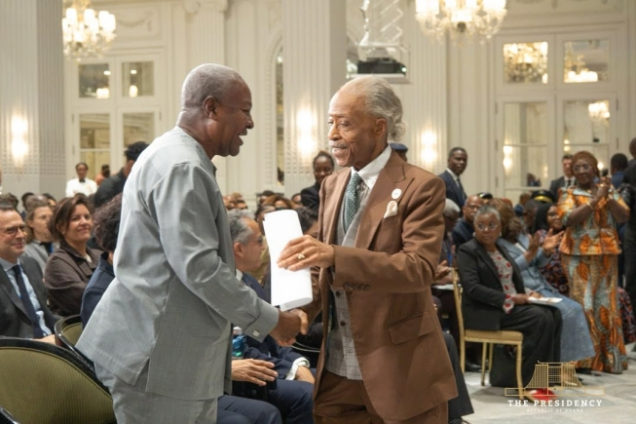
The President was speaking at the Next Steps High-Level Side Event on Reparatory Justice on the sidelines of the 81st United Nations General Assembly in New York today (Wednesday, September 23, 2026).
The event was co-hosted by Ghana, Germany, and France as a follow-up to the historic adoption of a UN General Assembly Resolution and the High-Level Consultative Conference on Reparatory Justice held in Accra in June this year.
President Mahama stressed that the debate on restitution was not about static objects in museum cases.
"This is not a story about static objects in museum cases. It is a story about people. It is a story about dignity. It is a story about an unfinished journey toward justice," he stated.
Citing Ghana's experience, the president recalled the British destruction of Kumasi in 1874 and the looting of the palace of the Asantehene.
"A century and a half later, in 2024, a portion of that heritage returned, including the sacred Mpomponsuo sword. Its return reminded us that these are not mere relics of a bygone era. They belong to living traditions, active institutions, and communities that are still here," he said.
He said this story was replicated across the continent in Benin City in 1897, at Maqdala in Ethiopia, and in Abomey in Benin.
President Mahama, however, said the most heartbreaking form of dispossession was the removal of the physical remains of ancestors.
"In 1838, King Badu Bonsu II of Ahanta rebelled against Dutch colonial domination. The Dutch authorities executed him by hanging and after decapitated him. His head was sent to the Netherlands for phrenology studies and was preserved in a jar of formaldehyde for 170 years. Rediscovered by a Dutch journalist in 2002, the head was finally returned to Ghana in 2009.
"And this is where I say, ladies and gentlemen, human remains are not collectibles. They are not specimens. They are our ancestors. They are our fathers, mothers, kings, and elders. Restoring them is not a matter of legal ownership; it is a fundamental test of our shared human dignity," he stressed.
President Mahama rejected the argument that restitution must wait until African nations build modern facilities.
"Too often, we hear the argument that restitution must wait until African nations build modern facilities to secure their heritage. Let us reject this narrative. Capacity constraints must never be used as a justification for continued possession. Capacity must serve as a bridge to return, not a barrier to justice," he stated.
He stated that Africa was already building the infrastructure of the future through the African Union's Agenda 2063 flagship project, the Great African Museum, and the AU-EU Museum Partnership, as well as Ghana's own construction of state-of-the-art national and traditional institutions to preserve, research, and exhibit returning treasures.
"Where gaps in technology, digitisation, or conservation exist, the solution is simple: Invest in them through genuine multilateral partnership," he added.
The president said cultural heritage was not a luxury to be addressed after economic development, but an engine of development.
"Properly preserved and showcased, it fuels education, identity, international tourism, and the booming creative economy," he said.
He, therefore, called on multilateral development banks, international financial institutions, global foundations and private sector partners to invest deliberately in Africa's cultural infrastructure, including regional archives, conservation laboratories, digitisation initiatives and professional training for a new generation of African curators and historians.
President Mahama described the adoption of the UN Resolution as an “indispensable moment of global truth”; adding that, truth is not the destination but the starting line.
He explained that the High-Level Consultative Conference convened by Ghana in Accra in June sought to answer the question:
"Our answer was clear: We must move from acknowledgement to action, from commitments to implementation. The adoption of the Accra Next Steps Commitments on Reparatory Justice provided the blueprint," he said.
President Mahama acknowledged progress made by some holding nations.
"We acknowledge and salute the progress made. We thank the Netherlands for cataloguing 2,000 Ghanaian artefacts for return.
We acknowledge Germany's engagement with our Kpando traditional area, France's legislative frameworks, and the return of the Djidji Ayokwe talking drum to Côte d'Ivoire. But moral justice cannot rely on piecemeal generosity or isolated acts of goodwill," he said.
President Mahama said the work was ultimately about the children who would inherit the world in Kumasi, Benin City, Addis Ababa, London, Kingston and New York.
"When a young African child enters a museum on her own continent and touches the tangible proof of her ancestors' brilliance, she learns that her history did not begin with subjugation. She learns that her ancestors built empires, mastered metallurgy, engineered complex political systems, and created sublime art. Our young people must inherit more than the story of what Africa lost. They must inherit the story of what Africa created," he said.
President Mahama said past trauma must not sentence the world to permanent estrangement. "Ghana does not come to this hall to assign guilt for the past. We come to forge a partnership with the present to repair the future. The story of Africa's cultural heritage cannot end with its removal. It must continue with its return.
"Let this UN General Assembly be remembered not as the place where we agreed on the past, but as the moment we built the future together," the president said.
Latest Stories
-
Skills Bridge Ghana Foundation trains 50 professionals in solar energy
2 seconds -
Photos: Mahama Ayariga inspects waste evacuation exercise at Agbogbloshie
1 minute -
Photos: Mahama meets world leaders at 81st UN General Assembly
1 minute -
From the Accra Reset to Reparatory Justice: Inside President Mahama’s diplomatic agenda in New York
3 minutes -
Photos: Ghana-China relations strengthened at China’s 77th anniversary celebration
5 minutes -
Majority says stronger enforcement drove rise in NACOC arrests
5 minutes -
He took fees above legal limit – Inusah Fuseini alleges in Baffour Awuah case
7 minutes -
Jan Alessie joins African Collaborations Group advisory board
7 minutes -
It has absolutely nothing to do with Salomey – Inusah Fuseini on Baffour Awuah’s EOCO case
16 minutes -
GES orders SHS heads to refund unauthorised fees collected from parents
19 minutes -
African Collaborations Group appoints Paulo J. Cruz as founding CEO
21 minutes -
Ethiopia and Tigray accuse each of launching offensives, fuelling fears of new war
21 minutes -
Teshie residents turn to wastewater as desalination plant shutdown deepens water crisis
25 minutes -
EPL: Semenyo earns Player of the Month nomination for September
26 minutes -
576 volunteers help remove 51.5 tonnes of waste from Nungua Beach, Accra
27 minutes