

Audio By Carbonatix
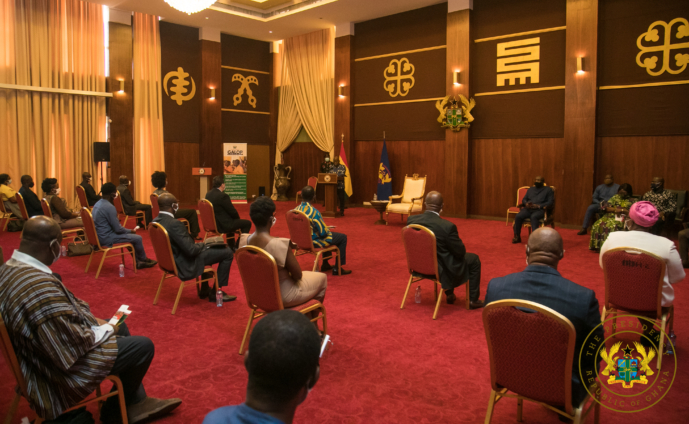
President Nana Akufo-Addo has launched the Ghana Accountability and Learning Outcomes Project (GALOP).
The Project is to help drive standards and quality in some 10,000 low-performing basic schools across the country.
Launching the Project on Thursday at Jubilee House, president Akufo-Addo indicated that, in spite of the numerous steps government has taken, over the last three and half years, to improve basic education in the country, a lot more work needs to be done.
According to the president, “we must address the problem of low learning outcomes that reflect in the performance of some of our children at the Early Grade Reading Assessment (EGRA), Early Grade Mathematics Assessment (EGMA), and Basic Education Certificate Examination (BECE).”
To achieve the desired improvement in learning for all of Ghana’s children, who go through the school system, in literacy, numeracy and critical thinking skills, government, the president said, is determined to ensure that children in every part of the country are taught by professional teachers.
“We remain focused on ensuring equitable teacher deployment and strengthening accountability regimes. That is why government is pleased to be collaborating with the World Bank in introducing GALOP,” he added.
Under GALOP, government will invest some $219 million on a comprehensive set of interventions that address constraints from teaching to learning in our schools.
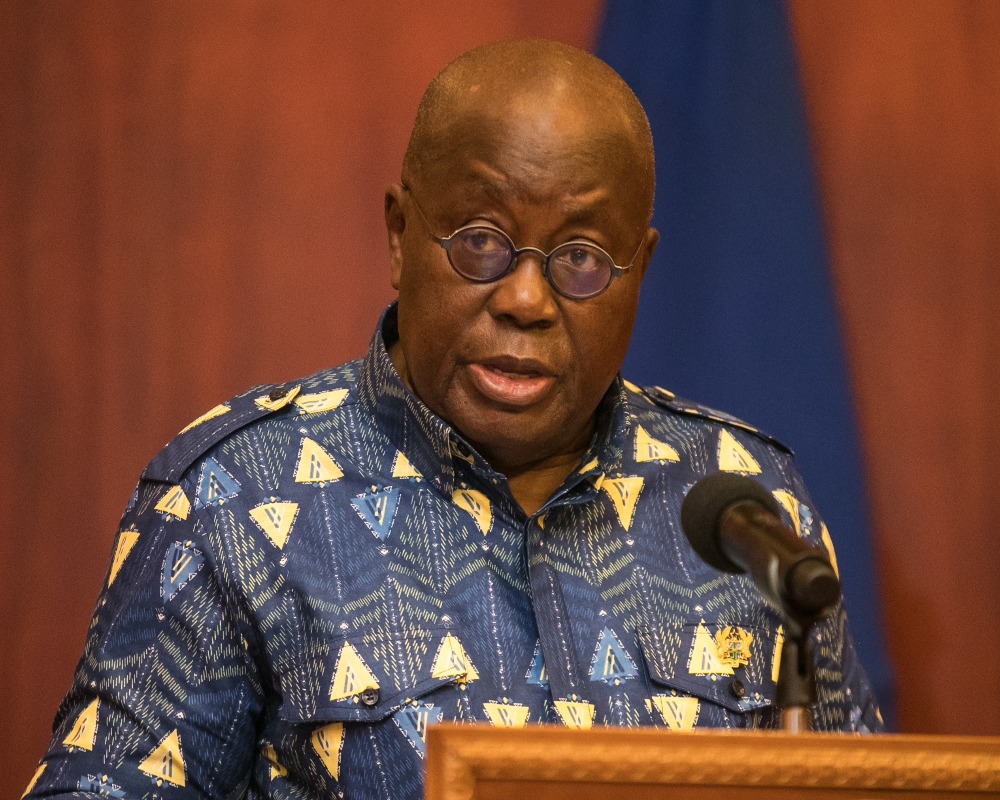
“Through this Programme, teachers, in the early grades, will be provided with continuous training, in line with the new curriculum; schools will receive teaching and learning materials; heads of schools will be trained on improved school management techniques; and supervision and assessment systems will be strengthened,” he said.
President Akufo-Addo added, “10,000 low-performing basic schools, across the country, have already been selected to benefit from the Project, and I am confident that the implementation of GALOP will help drive standards and quality in these schools.”
Expressing his appreciation to the World Bank and DFID, co-sponsors of the Project, the President reiterated the commitment of his government to the goals of the Project.
Education
Outlining the efforts made by government, upon his assumption of office in January 2017, to improve access to education, the president stated that “I made no secret my intention of putting education at the heart of my vision for the growth, development and transformation of Ghana.”
That is why government has implemented significant reforms to improve access, quality of education, infrastructure, teacher training and professionalisation, curriculum development, school inspection, and technical and vocational education and training.
Through the Free SHS policy, president Akufo-Addo noted that 1.2 million Ghanaian children, the largest in the history of the country, are now in the country’s education ecosystem, 400,000 of whom would otherwise have been excluded.
Additionally, he added that “over the last three and a half (3½) years, we have done a significant amount of work to boost education at the primary school level. In September 2017, we introduced a new curriculum for kindergarten to primary school, that reflects the realities of our aspirations.
"Under this administration, we have increased the capitation grant by 120%, from ¢4.50 per child to ¢10.00. We continue to invest in infrastructure, and in the supply of teaching and learning materials for our children.”
On improving the welfare of teachers, President Akufo-Addo told the gathering that Government has restored, since coming into office three and a half years ago, and paid up to date teacher trainee allowances, which were abolished by the previous administration.
In addition to the yearly average increase in salaries of ten per cent over the last three years, government is, for the first time in our history, paying a professional allowance to teachers.
“We have cleared the arrears, and promotions due teachers have also been effected. At the start of the 2018/19 academic year, all Colleges of Education were upgraded to university colleges. A 4-year Bachelor of Education (B.Ed) degree has been introduced in University Colleges of Education,” he said.
He continued, “This means that, soon, a first degree will be the minimum requirement for teaching at any level of the education system. Further, in September 2018, government rolled out the teacher licensure programme, aimed at improving professional standards in line with best practices across the globe.
"The aim of the teacher reform programme is to enhance capacity, and improve the quality of teacher training to enable teachers to respond to educational needs.”
Latest Stories
-
Mustapha Hamid misses out on NPP Vice Chairmanship by 31 votes despite early poll lead
7 minutes -
Kojo Bamba, Henry Nana Boakye and Nana Akomea elected NPP Vice Chairmen
53 minutes -
From Delta Force to NPP First Vice Chairman – Kojo Bamba’s political journey
58 minutes -
Police restore calm at Larteh following Odwira festival disturbance
2 hours -
‘All the camps will dissolve’ – Bawumia demands one NPP for 2028
2 hours -
There is no time to waste – Bawumia orders NPP to begin 2028 work
2 hours -
Sarkodie visits MobileMoney Fintech LTD
2 hours -
John Boadu unveils new NPP strategy to win back youth and modernise party
2 hours -
Hawa Koomson elected NPP National Women’s Organiser
2 hours -
John Boadu begins NPP rebuild from grassroots ahead of 2028 election
2 hours -
Titus Glover wins NPP National Organiser race on second attempt
2 hours -
Winning 2028 election won’t be easy; we must work harder – Bawumia
2 hours -
You’ll be part of 2028 campaign; there’s enough work for all of us – Bawumia to NPP aspirants
2 hours -
John Boadu moves to unite NPP after heated leadership contest
2 hours -
Today is not a day of victory but a day of responsibility and great unity – John Boadu
2 hours