

Audio By Carbonatix
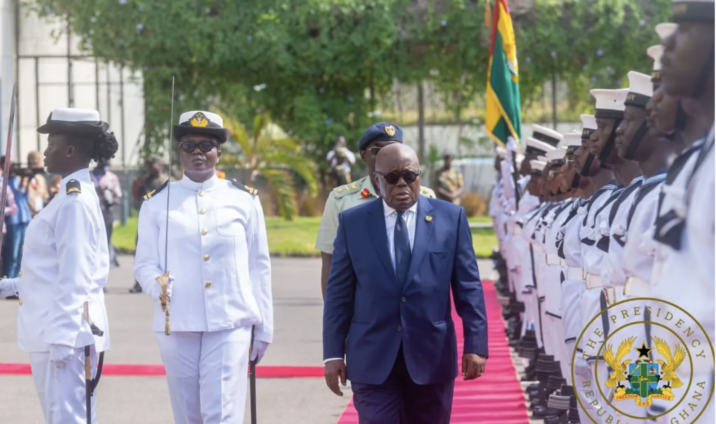
President Nana Addo Dankwa Akufo-Addo says Africa is committed to working with international maritime forces to overcome the growing maritime security threats on the continent.
Africa’s vast coastline and maritime resources held immense potential for economic development and growth, therefore, any threats to such prospects ought to be addressed head-on.
“These threats not only jeopardise our economic interests but also undermine the safety and wellbeing of our people,” the President stated while addressing the opening session of the African Maritime Forces Summit and Naval Infantry Leaders Symposium – Africa (NILS-A), in Accra.
Governmental and military leaders from more than 40 countries on four continents are participating in the three-day programme.
The African Maritime Forces Summit and NILS-A are combined this year for the first time to provide a unique venue for participants to address shared concerns and expand maritime cooperation and coordination.
The agenda is to strengthen strategic-level relationships to facilitate better regional cooperation when dealing with maritime threats.
Over the course of the next three days, African and international leaders will join a series of panels and focused discussions on maritime security challenges and opportunities.
Specific panels include Strategies for Cooperation and Models for Combined Operations, the Spectrum of Maritime Action: At Sea and In the Littorals, Assessing Maritime Security Interventions, and Countering and Prosecuting Illicit Maritime Activity.
President Nana Akufo-Addo expressed worry over the incidence of illegal oil bunkering, kidnapping at sea for ransom, illegal fishing, terrorism and drug trafficking, saying those were common threats across Africa’s territorial waters.
“These transnational crimes do not only threaten national and regional security, but they also come at a great cost to the economies of both coastal and non-coastal states.
“In the face of these challenges, it is imperative we foster greater cooperation and collaboration amongst African maritime forces by working together, sharing intelligence and coordinating our efforts,” he advised.
This is critical to address effectively maritime security threats and safeguard the continent’s maritime domain.
Although the Gulf of Guinea has witnessed a steady decline in incidents of piracy and armed robbery at sea, more needs to be done to fully operationalise the maritime security architecture, says the United Nations (UN).
On the situation of piracy and armed robbery at sea in the region, the incidents have witnessed a steady decline resulting from concerted efforts by national authorities, with the support of regional and international partners, regular deployment of naval assets by international partners, and piracy convictions, according to the UN.
The UN observes that, however, piracy in the Gulf had also morphed during the past decade, noting that the decline might be attributable to a shift by criminal networks to other crimes, such as oil bunkering and theft.
President Nana Akufo-Addo stated that the global maritime space, particularly the Gulf of Guinea Region, was a key route for international trade that connected all the major continents, from the Middle East of Asia to Europe and the Americas.
“The current crisis in the Red Sea and the re-routing of maritime traffic around the Cape of Good Hope to the Western Hemisphere and Europe, attest to the strategic importance of the Western Coast of Africa,” he emphasised.
The growing investments in the Region, particularly offshore oil and gas infrastructures, and the coastal trading and maritime traffic, were bound to increase, he projected.
“With this growing wealth of strategic importance, the region has to curb both the traditional and emerging maritime security threats,” he noted.
“In the face of these challenges, it is imperative we foster greater cooperation and collaboration amongst African maritime forces by working together, sharing intelligence and coordinating our efforts to address effectively maritime security threats and safeguard our maritime domain,” the President said.
Beyond the regional efforts, there had been other external initiatives such as joint exercises with other foreign naval ships, he stressed, adding that those exercises were aimed at improving the inter-operability amongst the naval forces and evaluating operational response to maritime threats.
“These exercises also provide appropriate platforms for heads of navies and coast guards to engage in dialogues and brainstorm on maritime security issues in the Gulf of Guinea,” he stated.
Virginia Palmer, the United States Ambassador to Ghana, was hopeful the summit and symposium would enhance the sharing of ideas in dealing with maritime threats.
She lauded Ghana for playing a significant role in addressing security issues in the sub-region.
Latest Stories
-
Adom FM Y2K Jam delivers a night of music, fashion and nostalgia
33 minutes -
Lawrence Kobena Nsarko Otoo, Esq
2 hours -
Bel-Aqua intensifies mental well-being campaign ahead of 15th anniversary
2 hours -
From banking to party finances: Alfred Kwadwo Thompson elected NPP Treasurer
2 hours -
George Christian Papa Mends
2 hours -
Ali Suraj elected NPP NASARA Coordinator
2 hours -
Mustapha Hamid misses out on NPP Vice Chairmanship by 31 votes despite early poll lead
2 hours -
Kojo Bamba, Henry Nana Boakye and Nana Akomea elected NPP Vice Chairmen
3 hours -
From Delta Force to NPP First Vice Chairman – Kojo Bamba’s political journey
3 hours -
Police restore calm at Larteh following Odwira festival disturbance
4 hours -
‘All the camps will dissolve’ – Bawumia demands one NPP for 2028
4 hours -
There is no time to waste – Bawumia orders NPP to begin 2028 work
4 hours -
Sarkodie visits MobileMoney Fintech LTD
4 hours -
John Boadu unveils new NPP strategy to win back youth and modernise party
4 hours -
Hawa Koomson elected NPP National Women’s Organiser
4 hours