

Audio By Carbonatix
The UN's International Court of Justice is to hear a case brought by South Africa accusing Israel of committing genocide against Palestinians in Gaza.
The submission also calls on the court to order Israel to stop military operations there.
The ICJ will deliver only an opinion on the genocide allegation as the case is not a criminal trial, although it is being keenly watched.
Israel has vehemently rejected the accusation as baseless.
In its submission, South Africa says Israel's actions "are intended to bring about the destruction of a substantial part of the Palestinian national, racial and ethnical group".
It says Israel's actions include "killing Palestinians in Gaza, causing them serious bodily and mental harm, and inflicting on them conditions of life calculated to bring about their physical destruction".
It calls for "provisional measures" to be implemented by the court, including that Israel cease all military activities in Gaza.
Israeli President Isaac Herzog called the accusations "atrocious and preposterous".
"We will be in the International Court of Justice and we will present proudly our case of using self-defence… under humanitarian law," he said.
He added that the Israeli army was "doing its utmost under extremely complicated circumstances on the ground to make sure that there will be no unintended consequences and no civilian casualties".
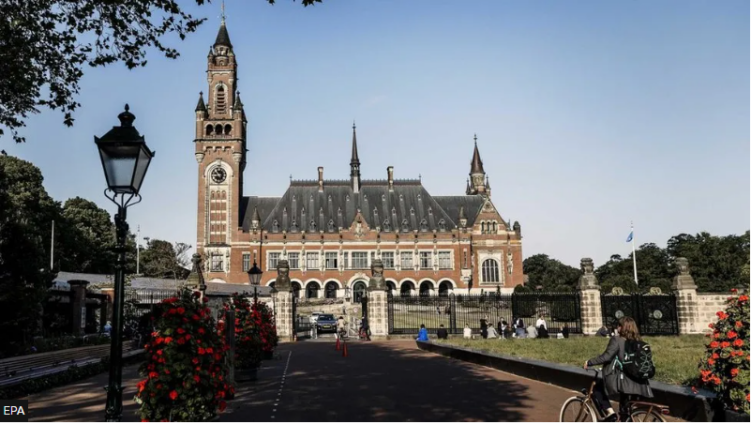
The ICJ - the UN court based in the Hague in the Netherlands - could rule quickly on South Africa's request for Israel to suspend its military campaign - but a final ruling on whether Israel is committing genocide could take years.
ICJ rulings are theoretically legally binding on parties to the ICJ - which include Israel and South Africa - but are not enforceable.
In 2022, the court ordered Russia to "immediately suspend military operations" in Ukraine, an order that was ignored.
South Africa has been highly critical of Israel's military operation in Gaza, and its governing African National Congress has a long history of solidarity with the Palestinian cause.
It sees parallels with its struggle against apartheid - a policy of racial segregation and discrimination enforced by the white-minority government in South Africa against the country's black majority, until the first democratic elections, in 1994.
In Gaza, more than 23,350 people have been killed, according to the Hamas-run health ministry, since the war began in the aftermath of Hamas's 7 October attacks on southern Israel. In those attacks some 1,300 people were killed - mainly civilians - and about 240 others taken hostage.
Latest Stories
-
GPL 2026/27: Medeama ease past Basake Holy Stars
8 minutes -
Appiah Adomako writes: Why DVLA must stop treating every expired licence holder as delinquent
11 minutes -
Localization must transfer decision-making power, not just project responsibilities
21 minutes -
Modernising Ghana’s traditional markets through the 24-Hour Economy markets initiative
23 minutes -
New economy will boost local production and create jobs – Finance Minister
29 minutes -
Real-Time VAT on cross-border digital services – not a new tax and does not violate double taxation principle
1 hour -
Digitalisation, AI key to Ghana’s tourism transformation – GHATOF
2 hours -
Stronger GTA-private sector partnership needed to grow tourism – GHATOF
2 hours -
Amazon eyes Ghana for broadband expansion after talks with Mahama
2 hours -
National Investment Quiz 2026: Six schools qualify for quarter-finals
3 hours -
‘Do not let Russia pay for its madness with lives of your people’ – Zelensky to Ghana, 46 other countries
3 hours -
6,079 promotion cases fully processed and paid – CAGD says amid nationwide teachers’ strike
3 hours -
Teacher unions to meet government Monday over nationwide strike
4 hours -
Photo story: Republic Bank-JoyNews Habitat Fair clinic wraps up after three days of housing solutions, expert engagement
4 hours -
National Peace Council urges investment in youth to sustain Ghana’s peace
4 hours