

Audio By Carbonatix
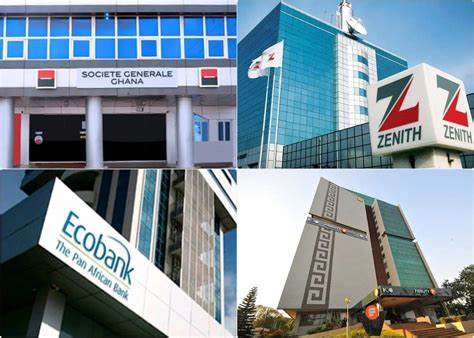
Banks operating in the country recorded 18.18% growth in profit in the first two months of 2022 to ¢1.3 billion.
According to the Bank of Ghana, trends in the financial soundness indicators remained positive, underpinned by strong solvency, liquidity, and profitability.
Net interest income grew by 10.3% to ¢2.2 billion. This is compared to 10.9% the same period a year ago.
Net fees and commissions also went up by 11.8% to ¢486 million, lower than the growth of 13.7% registered during the same period last year.
Other income of the banks stood at ¢383.2 million, representing 95.5% growth, compared with a contraction of 16.5% in the same period last year.
These developments, the Central Bank, said resulted in a 16.9% growth in operating income to ¢3.1 billion.
However, operating expenses went up by 21.3% on account of higher administrative costs and emoluments, relative to a contraction of 0.3% in the same period last year.
In terms of the financial soundness indicators, the Capital Adequacy Ratio of the Industry was 19.6% at end-February 2022, well above the current 11.5% regulatory minimum threshold.
Core liquid assets to short-term liabilities was 24.2% in February 2022, compared with 26.5% in the previous year.
Improvements in asset quality continued into 2022, with the Non-Performing Loans (NPL) ratio declining to 14.4% on average, at end-February 2022, compared with the NPL ratio of 15.3% in February 2021.
Total assets hit ¢187.8bn
Total assets stood at ¢187.8 billion in February 2022, representing 23.5% annual growth, compared with 18.5% growth in the previous year.
The growth in assets was on the back of increased deposits and borrowing. Total deposits recorded a year-on-year growth of 18.2% to ¢123.0 billion.
Borrowing increased significantly by 78.8% to ¢25.5 billion, relative to the contraction of 23.4% in the previous year.
The rebound in credit growth continued in the first two months of 2022, with a 70.7% increase in new advances to ¢8.0 billion, compared with 24.6% growth in the same period last year.
Credit to private sector rebounds
Meanwhile, credit to the private sector continued to recover, consistent with the rebound in economic activities.
In nominal terms, annual growth in private sector credit increased significantly to 17.1% in February 2022 compared with 7.4% in the same period of 2021. In real terms, private sector credit grew by 1.2% relative to a contraction of 2.7%, over the same comparative period.
The latest credit conditions survey by the BoG revealed tightened credit stance on loans to enterprises.
However, demand for credit by households and small and medium sized enterprises are projected to increase in the near to medium-term.
Latest Stories
-
BRICS Or Balance? What Ghana’s bid really means
13 minutes -
GPRTU wants full TRAFFITECH-GH implementation to start in 2027
32 minutes -
Mahama announces plans to import electric wheelchairs for PWDs
36 minutes -
KGL U17 Colts 2026: Western beat Prempeh Elite Academy to set up final final with Greater Accra Region
54 minutes -
Late Solanke strike salvages 10-man Spurs draw at Man United
1 hour -
Gender Ministry to monitor welfare of Nana Akua Addo’s children amid domestic violence case
1 hour -
Benedict Okyere Yeboah: Ghana’s football problem goes beyond sacking a coach
1 hour -
GPL 2026/27: Darkwah Wiafe’s winner sees All Blacks beat Kotoko
1 hour -
ITF World Tour : Patel Wins Boys’ Singles Final at J100 Accra
2 hours -
Ghana must pursue BRICS partnership if it brings economic benefits – Kpebu
2 hours -
Success and Wright Claims J100 Accra Girls’ Doubles Championship
2 hours -
ITF J100: America’s Wright wins J100 Accra Girls’ Singles Title
2 hours -
Expedition hopes to find aviator Amelia Earhart’s plane on remote island
2 hours -
US seeks changes to rejected $109m health compact with Ghana – Mahama
2 hours -
Nine dead in mass shooting at Pennsylvania home
3 hours