

Audio By Carbonatix
The Ghana Statistical Service (GSS) has released the findings of its latest Integrated Business Establishment Survey (IBES), providing a comprehensive map of the nation’s 2,644,358 recorded businesses.
The data paints a picture of a resilient and evolving enterprise landscape where non-traditional operations play a critical role in national commerce.
While the majority of businesses, approximately 1.87 million (70.6%), are conducted within fixed structures, the survey highlights the massive scale of the informal and semi-formal sectors.
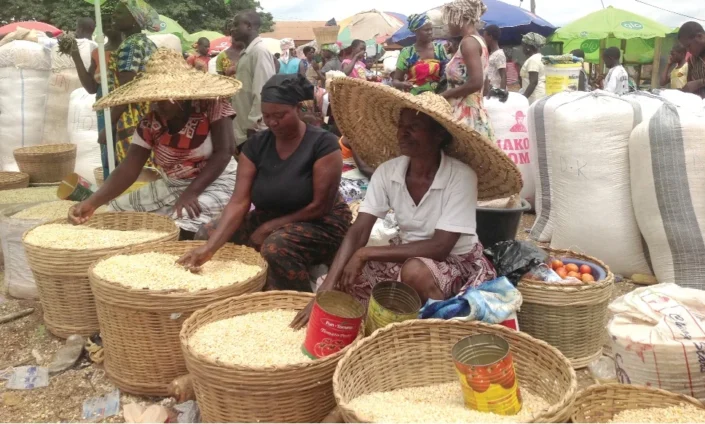
Enterprises operating in open spaces and mobile units now account for nearly 30% of all businesses in Ghana. These 776,668 entities are more than mere points of trade; they are essential pillars of daily access to goods and services.
The economic footprint of open-space businesses is particularly striking:
- Employment: These businesses alone provide livelihoods for over 922,000 people.
- Urban Concentration: Activity is heavily concentrated in the Greater Accra and Ashanti regions, reflecting the high commercial demand of Ghana’s primary urban centres.
- Operating Hours: Nationally, 63.7% of these businesses operate at least six days a week. This figure rises to 77.5% in Greater Accra and 73.1% in Ashanti, while in the Northern Region, nearly half (48%) remain open seven days a week.
Gender and ownership dynamics
The IBES data reveals a significant gender lean within the sector. Nearly 80% of all persons engaged in open-space, fixed-location businesses are women, underscoring the sector's role as a primary engine for female economic empowerment in Ghana.
Furthermore, the data reinforces the indigenous nature of this micro-economy, with 99.2% of all open-space businesses being entirely Ghanaian-owned.
Beyond fixed spots and open stalls, the survey identified 82,920 mobile businesses operating nationwide.
These "businesses on wheels" or on foot further bridge the gap in local commerce, ensuring that even the most remote or transient populations have access to essential trade.
The GSS findings suggest that while formalisation remains a policy goal, the informal and semi-formal sectors remain the heartbeat of Ghanaian economic activity.
With high employment levels and a deep-rooted presence in every region, these non-traditional enterprises continue to be the primary source of income generation for millions across the country.
Latest Stories
-
Zanetor pledges to turn scientific research into jobs, industrial growth
54 minutes -
Trade Minister inspects site for Cape Coast garment factory
60 minutes -
$270m poultry investment to create 12,000 jobs under 24-Hour Economy
1 hour -
My petition against Special Prosecutor put on ice after political intervention – Kpebu
1 hour -
‘Don’t fail our teachers’ – Parents demand full implementation of strike deal
1 hour -
Ghana Baptist Convention ordains 92 ministers, urged to live above reproach
1 hour -
SIGA’s GH¢19.8bn SOE profit claim misleading – Bright Simons
1 hour -
Kpebu vows to publish full petition if case against OSP is thrown out
1 hour -
Central Regional Minister inspects projects in Assin South
1 hour -
Mahama must show stronger leadership in galamsey fight – Prof. Bokpin
1 hour -
Abu Jinapor defends Domestic Gold Purchase Programme, credits Bawumia with its introduction
1 hour -
I’ll beat NDC for third time through my development record in Karaga – Amin Adam
2 hours -
Denkyirahene hosts sixth Akwasidae, calls for unity, peace
2 hours -
Edem Agbana outlines development gains, future projects at Ketu North accountability forum
2 hours -
Let’s develop a culture of reading – Tourism Minister
2 hours