

Audio By Carbonatix
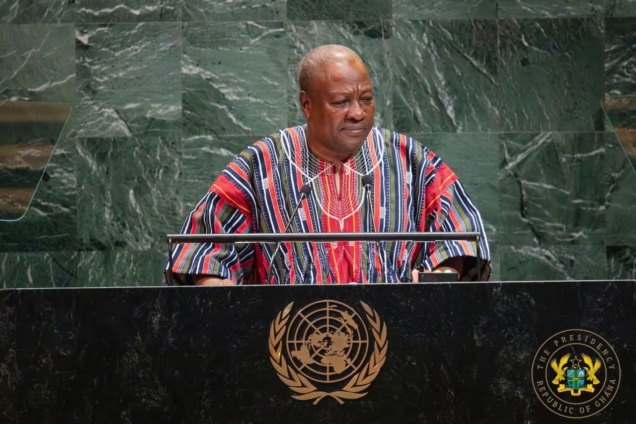
President John Mahama has raised alarm over what he calls the growing erasure of Black history in schools, public institutions, and media, urging the international community to safeguard the memory of Africa’s contributions and the struggles of enslaved Africans.
Delivering remarks at a United Nations event on slavery at the United Nations Headquarters on Tuesday, March 24, he stressed that historical slavery should not be reduced to statistics or sanitised narratives.
“When we speak of six million Africans trafficked to Brazil, two million to Jamaica, half a million to America, and 450,000 to Barbados, we must remember: these were human beings,” he said.
The President highlighted historical systems of oppression, including the Barbados Code of 1661, which allowed plantation owners to torture and kill enslaved Africans, and the Virginia doctrine of partus sequitur ventrum (1662), which legally ensured that children born to enslaved women were also enslaved, regardless of paternity.
President Mahama warned that modern-day erasure echoes these historical injustices.
He criticised educational materials in the United States that downplay slavery, such as a 2015 geography textbook referring to enslaved Africans as “workers,” and content from PragerU, which portrays slavery as a normal historical practice.
“Silence is a form of violence,” Mahama said. “When schools remove Black history courses, when books about slavery and segregation are banned, when museums and cultural institutions are prevented from showcasing Black history, we are repeating the same injustice—not in law, but in memory.”
President Mahama also underscored Africa’s critical contributions to building the New World.
“We laid roads, railways, buildings, and plantations; we cut sugar cane, picked cotton and cocoa, descended into mines, and wet-nursed children. Yet today, the silence about these contributions is deafening.”
The President called for a renewed commitment to teaching the truth about slavery and its legacies, describing it as a safeguard against forgetting.
“Erasing history does not change it,” he said. “It only ensures that the injustices of the past are repeated in memory and society.”
Latest Stories
-
Kwaku Azar writes: A-G vs OSP
14 minutes -
Mfantsipim–Adisadel rivalry built excellence, not division – Sam Jonah
39 minutes -
Vice President launches Mfantsipim’s 150 years of shaping Ghana’s greatest mind
56 minutes -
I assure Otumfuo, Mahama will join him to commission KNUST Teaching Hospital by end of this year – Haruna Iddrisu
2 hours -
Gov’t to roll out free special education for persons with disabilities from July 1 – Education Minister
2 hours -
“We used it to test our officiating officials’ readiness” – Bawah Fuseini after CAA Athletics event
2 hours -
Volleyball emerges as Ghana’s fastest rising sport
3 hours -
National Sports Fund needs strong leadership from the top – Administrator David Wuaku
3 hours -
JoySports Exclusive: Steve McLaren in talks with GFA after expressing interest in Black Stars job
3 hours -
Fire guts auto parts warehouse at Bubuashie, one fire officer injured
3 hours -
I owe my victory to coach Ofori Asare – Allotey after winning WBA Africa Gold Super Flyweight belt
3 hours -
Church of Pentecost supports over 2,000 BECE candidates in Obuasi with career guidance seminar
5 hours -
Brandon Asante and Coventry all but promoted to Premier League despite Sheffield Wednesday draw
5 hours -
GPL 2025/26: Late Kwartemaa strike downs Hearts in Tema
5 hours -
Ghana Faces Sierra Leone Moment as Prosecutorial Powers come under strain
5 hours