

Audio By Carbonatix
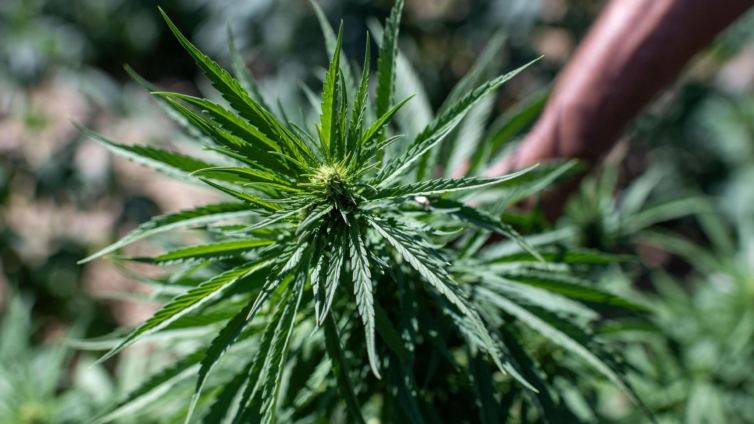
The government has introduced new conditions for entry into Ghana’s medicinal cannabis industry, requiring investors to secure confirmed buyers before obtaining licences to operate.
The Minister for the Interior, Muntaka Mohammed-Mubarak, announced this at a press briefing in Accra on Thursday, February 26.
He said the measure is intended to prevent diversion of cannabis into the illegal market and to protect public safety.
Alhaji Mohammed-Mubarak stated that applicants must show a clear market for their produce as part of the licensing process.
He said authorities would not grant licences to individuals who cannot identify who they intend to sell to.
“We won’t give you the licence if you don’t show us who you are going to sell it to. You need to have an off-taker,” he said, adding that the government will not permit cultivation without secured buyers.
The directive introduces stricter operational conditions in the rollout of Ghana’s medicinal cannabis programme. It affects farmers, investors, and processors seeking to enter the sector.
The policy is being implemented under the Narcotics Control Commission Amendment Act, 2023 and the Cannabis Regulations, 2023. These laws provide legal backing for the cultivation and management of cannabis strictly for industrial and medicinal purposes.
Alhaji Mohammed-Mubarak stressed that recreational use of cannabis remains illegal. “For the avoidance of doubt, cannabis with more than 0.3 percent THC remains a prohibited narcotic,” he said.
He outlined additional controls that prospective operators must meet.
According to him, a total of 11 different licences are required across the value chain, including cultivation, processing, transportation, import, and export. Each licence is activity-specific and non-transferable.
“You cannot cultivate and assume you can transport. You need another licence for that,” he explained.
The minister also said Ghana does not currently produce the specialised low-THC cannabis seeds required for the programme. As a result, all seeds must be imported under licence.
“Government is not positioning itself to provide the seeds. It is a business opportunity for those who want to import,” he said, while encouraging research institutions to develop local seed capacity over time.
To prevent abuse and diversion into illegal channels, the Interior Ministry, working with the Narcotics Control Commission and other security agencies, will apply surveillance and enforcement measures. These include GPS tracking, drone monitoring, and unannounced inspections of licensed facilities.
Security agencies such as the police, immigration service, prisons service, and the National Investigations Bureau will take part in enforcement.
Mr Mohammed-Mubarak warned that failure to comply with the regulations could have consequences for the country’s standing internationally. “If we get it wrong, Ghana could easily be blacklisted, and all the efforts will come to nothing,” he said.
He added that licensed facilities must not be located within 100 metres of schools or residential areas. Operators are also required to submit quarterly returns or face sanctions.
On the economic outlook, the Minister said although the sector has the potential to generate substantial revenue, the government’s immediate concern is public safety.
“Our emphasis is more on security and public safety than on money. If we do it right, the benefits will come,” he said.
The introduction of the off-taker requirement is expected to shape participation in the sector. It limits entry to investors who can show full commercial readiness from production to sale.
For many local farmers and small-scale entrants, the directive raises the entry threshold. It indicates that participation will require not only land and interest but also firm market arrangements and capital.
Mr Mohammed-Mubarak said the government remains open to engagement but will enforce the rules. “Our doors are open 24/7, but we will make sure the intent of the law is fully achieved,” he said.
Latest Stories
-
Trade Minister applauds GUTA as a pillar of economic growth; Prez Mahama honoured
50 minutes -
President’s brother’s takeover of Damang Mines is ‘untidy’ – Alhassan Tampuli
56 minutes -
It’s not true that gov’t decided not to renew the lease for Gold Fields – Bobby Banson
60 minutes -
Ghana to boost tomato production with 60-hectare irrigated farms and processing initiatives
1 hour -
E&P’s takeover process of Damang Mines was very clean – Inusah Fuseini
1 hour -
Damang takeover: There is not going to be any job loss; it is a lease change – Bobby Banson
2 hours -
Gold Fields didn’t stop mining at Damang mines; such claims are untrue – Bobby Banson
2 hours -
Engineers and Planners currently operate only in Ghana – Bright Simons
2 hours -
Lands Minister has no legal basis to restrict lease to Ghanaian firms – Bright Simons
2 hours -
Gov’t’s refusal to renew Gold Fields’ lease was simply untenable – Bright Simons
2 hours -
SOS Children’s Villages Ghana deepens partnership with Gender Ministry
3 hours -
Gender Ministry celebrates Christina Koch, reaffirms commitment to empowering girls
3 hours -
Live stream: Newsfile digs into E&P’s takeover of Damang Mines, OSP powers and Anti-LGBTQ Bill
3 hours -
Moody’s maintains Ghana’s rating at Caa1, revises outlook to positive
4 hours -
Zambia elevates tourism education to national priority as President Hichilema backs continental summit
4 hours